

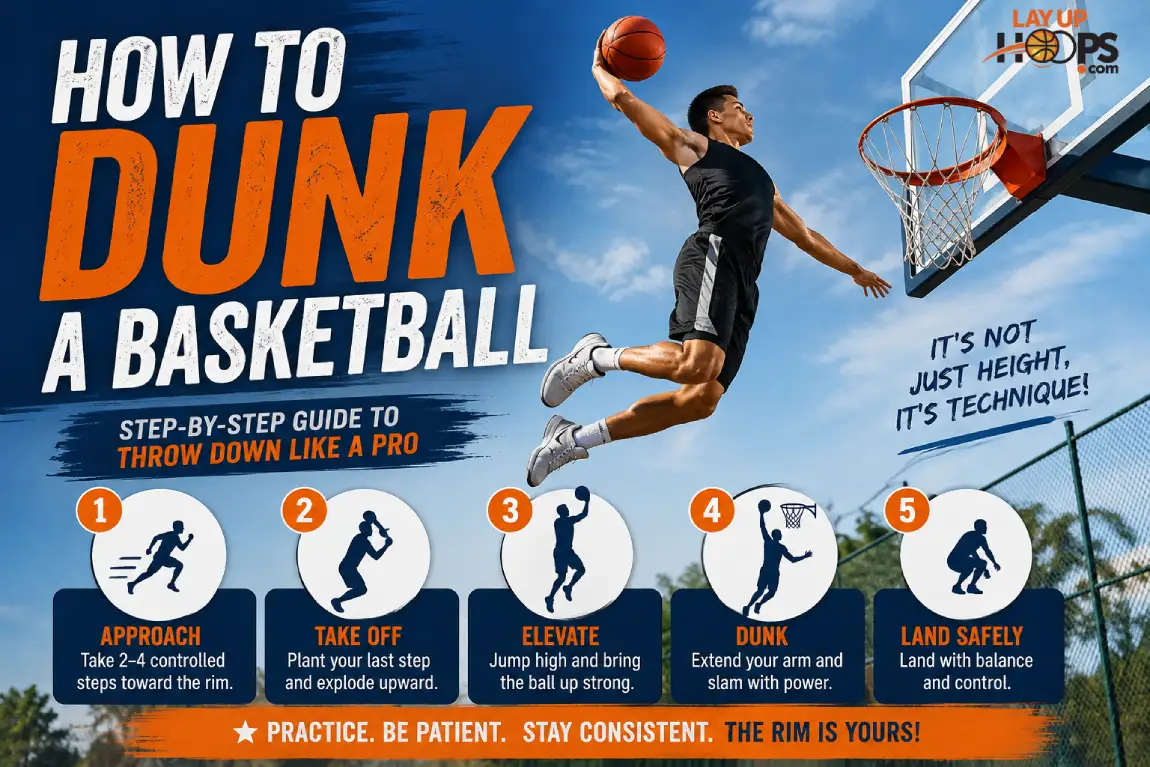
To dunk on a regulation 10-foot rim, your hand needs to reach roughly 10 feet 6 inches, because the ball has to clear the rim, not just your fingers. Subtract your standing reach from 126 inches and you have your target vertical. For most adults between 5’10” and 6’2″, that number lands somewhere between 28 and 36 inches.
That’s the whole math. What follows is everything the math doesn’t tell you, including the reason so many people can grab the rim, train for another year, and still never throw one down.
The three numbers that decide everything
Your height barely matters. What matters is how high you reach, how high you jump, and how much room the ball needs.
Most guides get the first one wrong, and it poisons everything downstream.
Measure your standing reach, don’t estimate it
Stand flat-footed against a wall, feet together, heels down. Reach up with one arm as high as you can, shoulder pressed up toward your ear. Mark the top of your middle finger. Measure from the floor. That number is your standing reach, and it is the single most important measurement in this entire article.
Do not use a formula to guess it. Half the sites ranking for this keyword multiply your height by 1.33 and call it done. That ratio comes from the NBA Draft Combine, where roughly half of measured players fall between 1.32 and 1.35, with a median around 1.335. Those are men selected across decades specifically for having long arms. You are probably not one of them.
Even inside that population the spread is enormous. Luol Deng measured 6’7″ with a 9’0.5″ standing reach. Matt Barnes measured 6’6.75″, basically identical height, with a standing reach of 8’0.5″. A full foot of difference between two players the same size. Tyler Ulis and Isaiah Thomas were both listed at 5’9″, and their standing reaches differed by nearly 3 inches.
Two people the same height can need verticals 5 inches apart. If you train toward a number you estimated instead of measured, you are training toward the wrong number.
What you’re aiming for
The rim sits at 120 inches. To dunk one-handed with any control, your hand needs to get to about 126 inches, because the ball itself is roughly 9.5 inches across and has to clear the ring.
Here’s what that means at common heights. The reach column is a range, not a promise, because arm length varies. Measure yours and use the real figure.
| Your height | Typical standing reach | Vertical to touch rim | Vertical to dunk |
|---|---|---|---|
| 5’6″ | 85 to 88 in | 32 to 35 in | 38 to 41 in |
| 5’8″ | 88 to 90 in | 30 to 32 in | 36 to 38 in |
| 5’10” | 90 to 93 in | 27 to 30 in | 33 to 36 in |
| 6’0″ | 93 to 96 in | 24 to 27 in | 30 to 33 in |
| 6’2″ | 95 to 98 in | 22 to 25 in | 28 to 31 in |
| 6’4″ | 98 to 101 in | 19 to 22 in | 25 to 28 in |
| 6’6″ | 101 to 104 in | 16 to 19 in | 22 to 25 in |
One thing this table can’t show you: a running approach usually produces 4 to 8 inches more than a standing jump. Most people measure their standing vertical, panic at the gap, and never realize their actual dunking vertical is meaningfully higher. Test both. The running number is the one that matters for dunking. Our guide on measure vertical jump walks through both protocols properly.
Why you can touch the rim and still can’t dunk
This is the question that fills every comment section on every dunking article on the internet, and almost nobody answers it straight.
Grazing the rim with your fingertips does not put you close. It puts you roughly 8 to 10 inches away. Three separate things stack up between those two moments, and they all work against you.
The clearance you never think about. When you touch the rim, only the very tip of your middle finger has to reach 120 inches. When you dunk, your whole hand plus a ball has to clear it. That’s the 6 inches built into the table above, and it’s the gap most people never account for.
Holding a ball costs you inches. Here is the part almost nobody writes down. Your arm swing is a real contributor to jump height, not a stylistic detail. Research measuring jumps with and without arm swing has found gains ranging from about 10% to as much as 25%, and one study of upper-body plyometric training recorded a 6.2 cm difference in mean jump height from arm-swing mechanics alone. When you carry a ball in one hand, you give up most of that arm’s contribution. For a 30-inch jumper, that’s often 2 to 4 inches gone before you leave the floor.
If you’ve ever thought “I jump lower with a ball in my hand,” you were right. You do. It isn’t nerves.
Your body protects itself. Approaching a rim you’re not sure you’ll clear makes you decelerate slightly on the last step. It’s involuntary and it costs you height. This one fixes itself with reps at a lowered rim, which is exactly why lowering the rim is worth doing.
Add those up and the honest version is this: if you can just barely graze the rim, you probably need 8 to 10 more inches of touch height before a clean dunk happens. Not 1 or 2. That’s months of work for most people, not weeks.
Where are you actually? The five stages
Work out which rung you’re on. It changes what you should train and how long it will take.
| Stage | What you can do | What it means |
|---|---|---|
| 1 | Touch the net | You need 10+ inches. Long project. Strength first. |
| 2 | Touch the backboard | 6 to 9 inches out. Real but distant. |
| 3 | Graze the rim inconsistently | 8 to 10 inches from a clean dunk. Closer than stage 2, further than you think. |
| 4 | Grab and hang on the rim | 4 to 6 inches out. This is when it becomes a technique and grip problem as much as a jumping one. |
| 5 | Get the ball above the rim but can’t finish | Zero inches out. Your problem is the ball, not the jump. Skip to the grip section. |
Stage 5 is the most misdiagnosed position in all of this. People who can already get a ball over the rim keep training their vertical for months when the actual fix takes a week.
What to train, in the order that works
Sequence matters more than exercise selection. Doing the right movements in the wrong order wastes months.
Strength first, always
Jumping is a strength expression. If your legs can’t produce force, teaching them to produce it faster gets you very little. That’s why beginners who go straight to box jumps stall out after a few weeks.
Build with squats, Romanian deadlifts, Bulgarian split squats, and calf work. A reasonable target before plyometrics become your priority is squatting around 1.5 times your body weight for reps with clean depth. Single-leg strength matters more than people expect, since most running dunks leave off one foot.
If you’re already strong and your vertical hasn’t moved in months, strength is not your bottleneck and adding weight to the bar won’t help. Our breakdown of [internal: vertical jump plateau] covers what to do instead.
Then plyometrics
Once there’s a base to work with, plyometric training teaches your body to release that strength fast. Box jumps to a height you can land cleanly. Depth jumps, where you step off a box and rebound upward immediately, training the stretch-shortening cycle. Broad jumps for horizontal power. Single-leg bounds for one-foot takeoffs.
Volume is where people wreck themselves. Plyometrics are a nervous-system stimulus, not a conditioning workout. Twenty to forty high-quality contacts twice a week beats two hundred sloppy ones, and the sloppy ones are how patellar tendinitis starts. The full progression is in exercises to increase vertical jump.
Do explosive work fresh. If yesterday’s squats left your legs dead, today’s depth jumps are both useless and risky.
Then the approach
Technique is the cheapest inches available and the most neglected. A well-executed approach adds several inches over a standing jump, and unlike strength gains, you can find some of it in an afternoon.
The penultimate step is the whole game. Your second-to-last step should be longer and lower than the ones before it, dropping your center of mass so your final step can convert forward speed into upward lift. Plant the takeoff foot slightly ahead of your body. Drive the opposite knee hard. Swing your free arm up with real intent.
Speed is not the goal. Controlled acceleration over three to five steps beats a full sprint, because a sprint you can’t decelerate into a plant just carries you forward past the rim. Plenty of people jump their worst when they run their fastest.
One foot or two?
Most people are naturally better at one, and it’s worth finding out which rather than assuming.
One-foot takeoffs convert running speed into height. They suit faster, springier athletes, they need less pure standing vertical, and they’re how the majority of in-game dunks happen. The tradeoff is that you can only carry the ball in one hand, so your ball control has to be reliable.
Two-foot takeoffs generate more raw vertical from a shorter approach, and you keep both arms available on the way up. They suit stronger, heavier athletes and anyone who dunks from a standstill or a rebound.
Test both properly across a few sessions before committing, because the difference between your one-foot and two-foot vertical can be 4 inches or more in either direction. Train the one you’re better at. There’s a full comparison in [internal: one foot vs two foot jumping].
The ball problem nobody writes about
Search any dunking forum and you’ll find the same post over and over: I can get the ball above the rim and it slips out, or bounces off the back of the ring, or flies twenty feet in the air. One player on a basketball forum described losing the ball at the exact moment of switching from reaching up to pushing down, and said he’d searched everywhere without finding anything useful.
He’s right that nobody covers it. Here’s the fix.
If you can’t palm the ball, you’re in good company. Most short dunkers never palm it. Two options work. The first is a cradle: rest the ball between your spread fingers and the inside of your forearm on the way up, then flick the wrist to release. The second is carrying it in both hands until the last moment and transferring to one hand at the top of the jump.
If it slips at the top, your release is late. You’re trying to convert an upward reach into a downward push while the ball is already unsupported. Release earlier, at the point where your hand is just clearing the ring rather than at maximum extension.
If it hits the back of the rim, you’re jumping forward instead of up. Fix the approach, not the release. Your takeoff foot is planting too far under you.
If it flies out on contact, you’re pushing the ball down instead of letting your hand pass over the rim and snapping the wrist. Dunking is a wrist action at the finish, not an arm action.
Grip strength helps more than you’d guess. Farmer’s carries, plate pinches, and dead hangs are twenty minutes a week and they make ball control at the top noticeably steadier.
Getting your first one down
Physically capable and actually dunking are two different states, and the bridge between them is mostly reps and confidence.
Lower the rim. Set it to a height where you have to jump nearly your max to dunk, and dunk there repeatedly. You’re building the motor pattern and killing the flinch. Raise it a few inches when it feels easy. This is the highest-return practice available and most people skip it out of pride.
Have someone lob it. Catching a lob and slamming it removes the ball-carry problem entirely for a session and lets you feel what being above the rim is like. It’s a confidence tool, not a cheat.
Use a smaller ball, but not a ping-pong ball. Older guides recommend starting with a ping-pong ball and progressing through tennis balls and softballs. That’s a relic. A ball that small teaches you nothing about the hand mechanics you’ll need. Start with a volleyball or a size 5 ball, which are close enough in size to transfer, and move up.
Warm up longer than you think. More than a few people find they can only dunk after thirty or forty minutes of moving. Explosive output climbs substantially with a proper warm-up. If you test yourself cold, you’re testing the wrong you.
Who probably won’t dunk, and that’s fine
Every other guide on this topic is relentlessly encouraging, and every other guide on this topic is selling a jump program. Here’s the version without the sales pitch.
Vertical jump is trainable, but it’s trainable within a range. A realistic gain for someone with no training history is 4 to 8 inches over a year of consistent, well-programmed work. Elite gains beyond that happen, but they’re the exception, and they usually belong to people who were already athletic and undertrained rather than people starting from zero.
Run that against the table. If you’re 5’6″ and need a 40-inch vertical, and you currently jump 20, you are asking for something that only a small number of people on earth have achieved. It’s not impossible. Spud Webb and Nate Robinson both won the NBA dunk contest at 5’7″ and 5’9″. They are also professional athletes and genetic outliers, which is precisely why we know their names.
On age: you can absolutely still train your vertical in your thirties and forties, and plenty of people get their first dunk after 30. What changes is recovery speed, tendon tolerance for high-impact plyometrics, and how much time you can safely spend on depth jumps. Progress is slower and the injury cost of overreaching is higher. If you’re over 30 and starting from a low base, budget years, not months, and lift more than you jump.
None of this means don’t train. Chasing a dunk builds explosiveness, strength, and speed that make you a genuinely better player whether or not the dunk arrives. It just means you should train because the work makes you better, not because a program promised you 15 inches in eight weeks.
Don’t hurt yourself getting there
Dunking puts you in the air over the most crowded patch of the floor, and landings are where things go wrong. Come down balanced, on both feet where possible, with your knees soft.
Hanging on the rim is worth understanding. In traffic, holding on until bodies clear underneath you is the safe play. In the open, let go, both because you don’t need it and because hanging on the rim when nobody’s underneath you is a technical foul.
And if you’re 15 and still growing, be careful with high-volume depth jumps and heavy loading. Growth plates and rapidly lengthening tendons are a bad match for repeated high-impact landings.
Frequently asked questions
How long does it take to learn to dunk?
It depends entirely on how far you are. Someone already grabbing the rim might need three to six months of focused work. Someone touching the net is likely looking at a year or more, if it happens at all. Anyone promising a specific timeline without knowing your standing reach and current vertical is guessing. There’s a full breakdown in [internal: how long to learn to dunk].
Can you dunk with a 30-inch vertical?
Yes, if your standing reach is around 96 inches or higher, which typically means you’re about 6 feet tall with average arms. At 5’8″ a 30-inch vertical gets you to roughly the rim, not above it. Standing reach decides this, not height.
Why can I touch the rim but not dunk?
Three reasons stack: the ball needs about 6 inches of clearance above the rim, carrying a ball in one hand costs you the arm swing on that side and typically 2 to 4 inches of jump, and most people unconsciously slow down on the final step. Grazing the rim usually means you’re 8 to 10 inches from a clean dunk.
Do I need to palm the ball to dunk?
No. Most players under 6 feet who dunk cannot palm a regulation ball. Cradle it against your fingers and forearm, or carry it in two hands and transfer at the top of the jump.
Does a running start help?
Substantially. A running approach usually produces 4 to 8 inches more than a standing jump by converting horizontal momentum into vertical lift. Test your running vertical, not just your standing one, before deciding how far away you are.
Is it too late to start at 30?
No, but be realistic. Strength and technique still respond well at any age. What declines is recovery capacity and tendon tolerance for heavy plyometric volume. Lift more, jump less often, and give yourself years rather than months.