

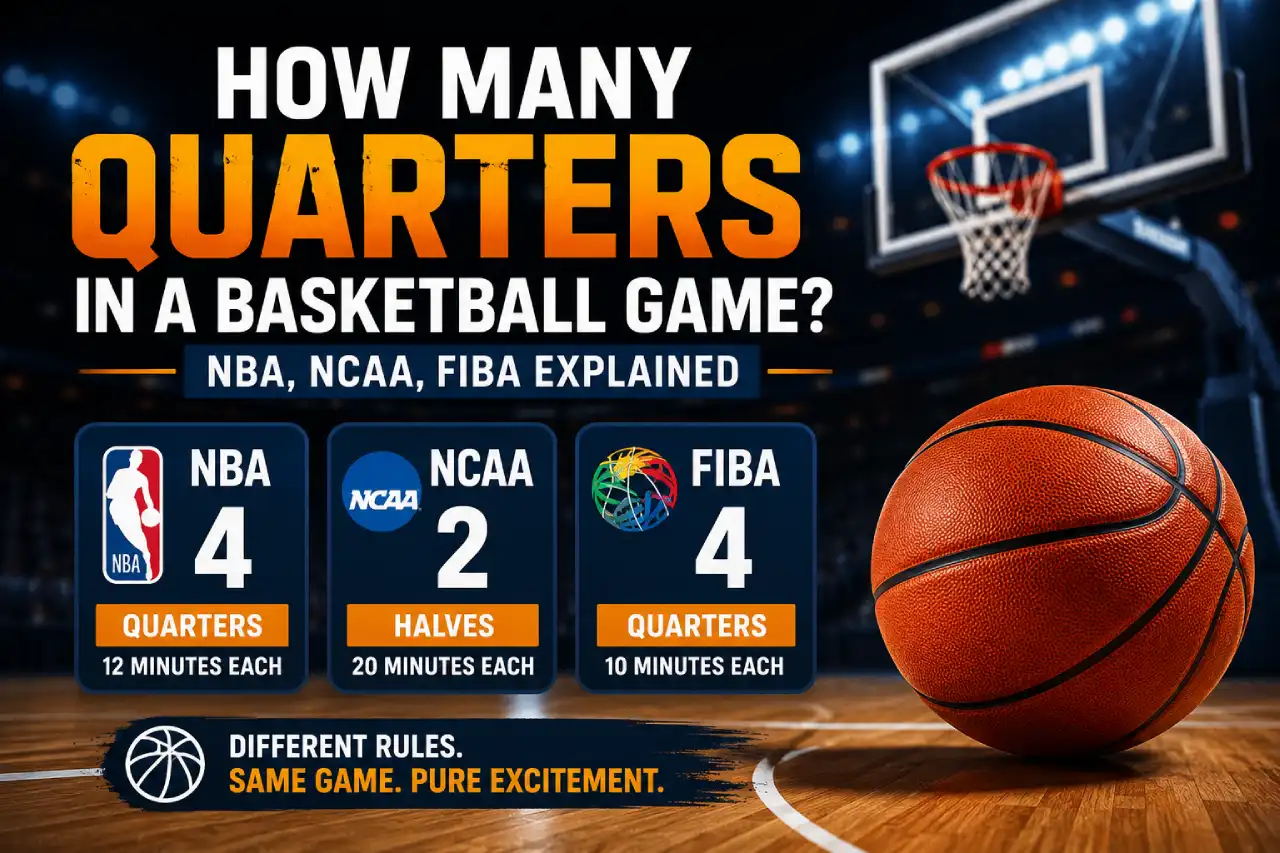
A basketball game has 4 quarters at almost every level. In the NBA, each quarter runs 12 minutes for 48 minutes of regulation.
The WNBA, FIBA international games, and NCAA women’s basketball play four 10-minute quarters. US high school games use four 8-minute quarters. The one major exception is NCAA men’s basketball, which doesn’t play quarters at all: it uses two 20-minute halves.
So the honest answer is “four, usually.” Here’s every level in one table, then the details that the number alone doesn’t tell you.
Quarters and Game Length at Every Level
| Level | Format | Minutes Each | Regulation Total | Overtime |
|---|---|---|---|---|
| NBA | 4 quarters | 12 min | 48 min | 5 min |
| WNBA | 4 quarters | 10 min | 40 min | 5 min |
| NCAA Men | 2 halves | 20 min | 40 min | 5 min |
| NCAA Women | 4 quarters | 10 min | 40 min | 5 min |
| FIBA (Olympics, international) | 4 quarters | 10 min | 40 min | 5 min |
| US High School | 4 quarters | 8 min | 32 min | 4 min |
| Middle School | 4 quarters | 6-7 min (varies) | 24-28 min | Varies |
| Youth Leagues | Varies | Often 8-min quarters or running-clock halves | Varies | Varies |
| FIBA 3×3 | 1 period | 10 min (or first to 21) | 10 min max | First to 2 points |
Every quarter-based game also splits into halves: quarters one and two make up the first half, three and four the second, with halftime in between.
The NBA: Four 12-Minute Quarters
The NBA plays the longest regulation game in basketball: four 12-minute quarters for 48 total minutes. Halftime lasts 15 minutes, and the breaks after the first and third quarters run about two and a half to three and a half minutes each.
Of course, nobody has ever watched an NBA game in 48 minutes. Timeouts, free throws, replay reviews, and the famously slow final two minutes stretch a typical game to somewhere between 2 and 2.5 hours of real time. The clock stops constantly, which is exactly why a 5-point lead with 40 seconds left is never safe.
The 48-minute format is nearly as old as the league itself. When the NBA’s ancestor launched in 1946, the pro game was built longer than the 40-minute college game on purpose: paying fans expected a fuller night of basketball.
The WNBA: Four 10-Minute Quarters
WNBA games run four 10-minute quarters, 40 minutes total, with the same 15-minute halftime and 5-minute overtimes as the NBA. It wasn’t always this way. The league played two 20-minute halves until 2006, when it switched to quarters. One underrated effect of that change: team fouls reset every quarter instead of every half, which means fewer long stretches of parade-to-the-free-throw-line basketball late in each period.
College Basketball: The Great Halves vs Quarters Split
College is where the “four quarters” answer breaks down, and where men’s and women’s basketball genuinely play different games.
NCAA men: two 20-minute halves
Men’s college basketball is the only major level in the world that still plays halves. Two 20-minute periods, 40 minutes total, one halftime, no quarter breaks. It’s a format with deep roots: the NCAA briefly experimented with four 10-minute quarters in the early 1950s, abandoned it after the 1954-55 season, and has played halves ever since. Critics inside the sport, including broadcasters like Jay Bilas, have argued for years that the men’s game should join the rest of the world and adopt quarters. So far, tradition is winning.
NCAA women: four 10-minute quarters
The women’s college game played halves too, until the 2015-16 season, when the NCAA approved a switch to four 10-minute quarters to improve the game’s flow. The change also rebuilt the foul-bonus system: teams now shoot two free throws on the fifth team foul of each quarter, and the count resets when the quarter ends.
Today the NCAA women’s format mirrors the WNBA exactly, which makes the pro transition seamless for players.
FIBA and International Basketball: Four 10-Minute Quarters
Everywhere outside the United States, from the Olympics and the FIBA World Cup to the EuroLeague and nearly every national league, the game is four 10-minute quarters, 40 minutes total. Halftime is 15 minutes, the other breaks are 2 minutes, and overtime is 5 minutes. FIBA itself made the switch from two 20-minute halves to the quarter format in 2000, so when you watch Team USA in the Olympics, the game is 8 minutes shorter than an NBA game even though many of the players are the same.
The exception with no quarters at all: 3×3
Olympic 3×3 basketball throws the whole structure out. There are no quarters and no halves: just one 10-minute period, and the first team to reach 21 points wins immediately, buzzer or not. If the score is tied after 10 minutes, overtime isn’t timed either; the first team to score 2 points takes the game. It’s the fastest format in basketball, and it’s the one format no “how many quarters” answer ever seems to mention.
High School, Middle School, and Youth Basketball
US high school basketball plays four 8-minute quarters under National Federation (NFHS) rules, for 32 minutes of regulation. Halftime is usually 10 minutes, and overtime periods are 4 minutes, one minute shorter than the pro and college standard.
Middle school games typically shrink to four 6- or 7-minute quarters, though this varies by state and conference.
Youth leagues are the wild west. Many play four 8-minute quarters; plenty of recreational leagues use two longer halves with a running clock that only stops in the final minutes; some leagues for the youngest kids play quarters as short as 5 or 6 minutes so attention spans survive.
There’s no universal standard, so if the exact format matters to you, check your specific league’s rulebook rather than trusting a general number. Shorter periods for younger players are intentional: small chunks of game time keep kids engaged and give coaches natural breaks to teach. It’s the same logic behind building skills through short games instead of long drills.
Why Quarters Exist in the First Place
Basketball didn’t start with quarters. When James Naismith wrote the original 13 rules in 1891, he established the game as consisting of two 15-minute halves, separated by a 5-minute break. Halves were the norm for decades, and the quarter format spread later, level by level: the pros built their game around four quarters, FIBA converted in 2000, the WNBA in 2006, and the NCAA women’s game in 2015.
The case for quarters is practical. More scheduled breaks mean more chances to rest players and adjust strategy, team-foul counts reset each period so games don’t devolve into free-throw contests, and (at the professional level, at least) quarter breaks conveniently fit television.
The case for halves is simpler: it’s how the men’s college game has always felt, and 40 minutes split in two produces its own late-half drama. Which is better is a genuine argument among coaches. That both formats still coexist in 2026 tells you neither side has won it.
Overtime: What Happens After the Fourth Quarter
Basketball doesn’t do ties. If the score is level when regulation ends, the game goes to overtime, and if it’s still tied, another overtime follows, repeating until someone wins.
- NBA, WNBA, NCAA (men and women), FIBA: 5-minute overtime periods
- US high school: 4-minute overtime periods
- Youth leagues: varies, from 2- or 3-minute periods to sudden-death formats
- 3×3: untimed, first to score 2 points
There’s no limit to how many overtimes a game can have. The most extreme case in NBA history needed six overtime periods to settle, which meant the two teams played the equivalent of nearly a fifth quarter and a half of extra basketball.
FAQ: Quarters in Basketball
Does basketball have 2 halves or 4 quarters?
Both, at most levels. The four quarters nest inside two halves: quarters one and two are the first half, three and four are the second. NCAA men’s basketball is the exception, playing two 20-minute halves with no quarters at all.
How long is halftime in basketball?
15 minutes in the NBA, WNBA, NCAA, and FIBA play. High school halftimes usually run 10 minutes, and youth leagues are often shorter still.
Why does men’s college basketball play halves instead of quarters?
Tradition, mostly. The men’s game has used two 20-minute halves for over a century, apart from a brief quarters experiment in the early 1950s. Every other major level, including the NCAA women’s game since 2015, has moved to quarters, and rule-change debates about the men’s format resurface almost every season.
How long does a basketball game actually last in real time?
Far longer than the game clock. An NBA game’s 48 minutes of play take about 2 to 2.5 hours in real time once you add timeouts, fouls, halftime, and reviews. College games typically finish in around 2 hours, and high school games in roughly 1.5.
Has the NBA always played 12-minute quarters?
The 48-minute game dates back to the league’s founding era in the late 1940s, designed to give fans a longer show than the 40-minute college game. The 12-minute quarter has been the NBA’s signature format for essentially its entire modern history.
Four quarters is the rule, but the clock behind them changes with the level: 12 minutes in the NBA, 10 in the WNBA, FIBA, and women’s college game, 8 in high school, and less as players get younger. NCAA men’s halves and 3×3’s single sprint to 21 are the two formats that break the pattern. Once you know which clock you’re watching, everything else about the game’s rhythm, from foul strategy to the timing of a comeback, starts making sense.