

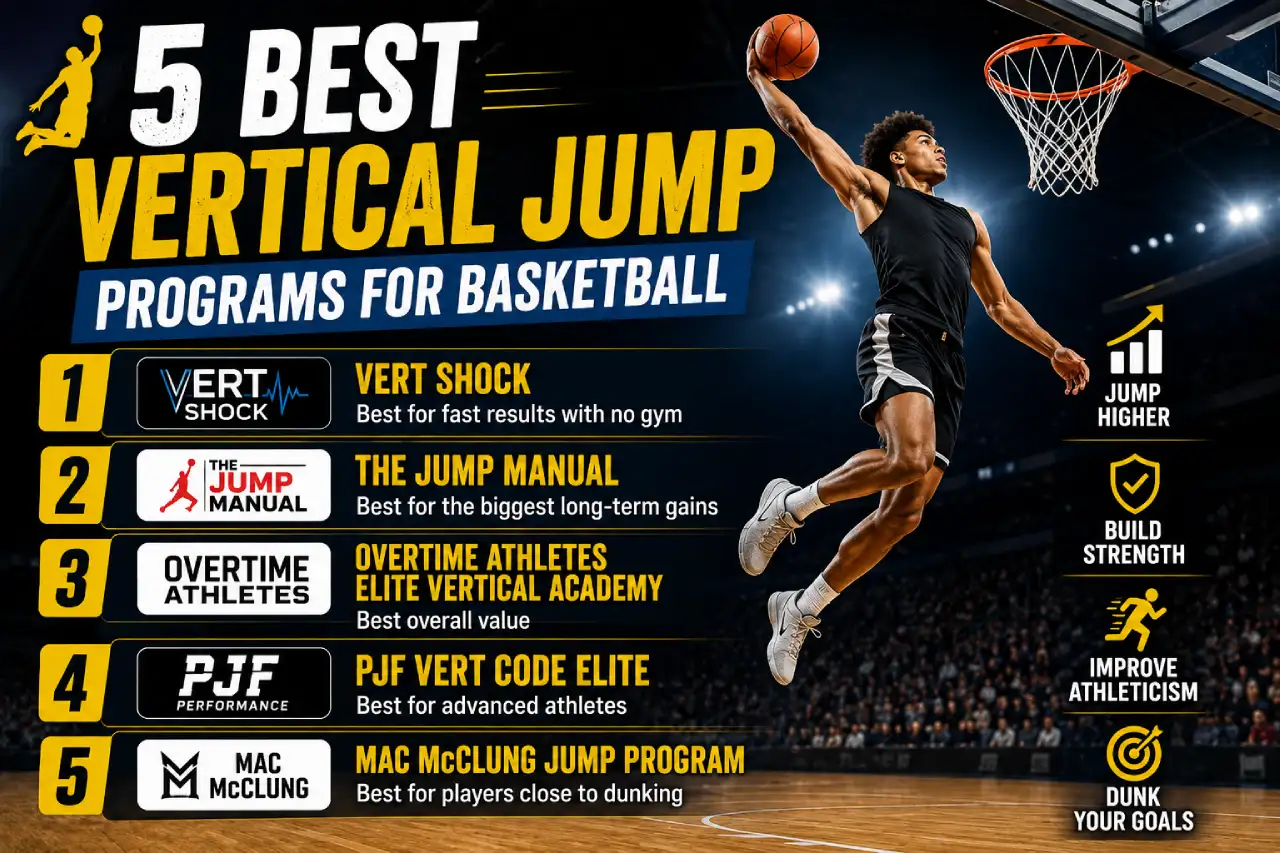
If you just want the fastest answer, there is no single best vertical jump program for basketball. There is the best one for your situation. A 15-year-old with no gym access needs a different program than a 22-year-old who already squats double bodyweight. So this guide does two things that the usual “top 10” lists skip. It matches each program to a real type of player, and it tells you honestly how many inches you can expect, because the numbers on most sales pages are fantasy.
Here is the short version, then the details.
Some links below are affiliate links. If you buy through them, we may earn a commission at no cost to you. It does not change our rankings, which are based on fit and results.
The Quick Pick: Which Program Fits You
| If this sounds like you | Start with | Why |
| No gym, want fast results, beginner or intermediate | Vert Shock | Bodyweight, 8 weeks, built on explosive plyometrics |
| Gym access, want the biggest long-term gain | The Jump Manual | Strength plus plyometrics over 12 weeks, gains that stick |
| You want to understand training, not just follow it | Overtime Athletes Elite Vertical Academy | Teaches the why, scales beginner to advanced, best value |
| Already athletic, chasing your last few inches | PJF Vert Code Elite | The most science-heavy option, built for advanced players |
| Already touching rim, just want to dunk | Mac McClung Jump Program | Dunk-specific drills and real palming work |
Pick the row that sounds like you and skip to that review below. Now, the part nobody tells you.
What Actually Adds Inches To Your Vertical
Your vertical comes from one thing: how much force you can put into the floor in a fraction of a second. Strength builds the size of the engine. Plyometrics teach you to fire it fast. The technique makes sure none of that force leaks out. Miss any of the three and you leave inches on the table. That is the honest core of every good program, whatever the sales page calls its “secret method.”
Now the numbers, because this is where the industry bends the truth.
When researchers pool the actual data, the gains are real but modest. A 2009 meta-analysis in the Journal of Strength and Conditioning Research combined 56 studies and found that plyometric training improved vertical jump by around 7 percent on average, which works out to roughly 1.5 inches. A more recent systematic review found plyometric work added about 5.2 cm (2 inches) and pure strength training about 9.9 cm (nearly 4 inches) over ordinary training, with the best results coming from combining the two. Read those numbers again. The best available evidence points to a few inches over a couple of months, not the 9 to 15 inches plastered across every sales page.
So who gets the big jumps? Two groups. Total beginners, because they start from zero on both strength and technique and have the most slack to take up. And genuine outlier responders, the ones whose transformation photos end up in the ads. If you already train hard and jump well, adding four inches is a serious, months-long project, and any program promising you twelve by next month is selling you the exception as if it were the rule.
The research also tells you what a good program should look like. Gains climb when training runs longer than about 10 weeks, when sessions are hard rather than just long, and when you mix different jump types instead of hammering one. Adding weight to your jumps, for what it is worth, did not improve results in the data. Keep that in mind when a program tries to sell you a weighted vest as the missing piece.
How We Judged These Programs (And How To Test Your Own Jump)
We did not rank these by which one pays the biggest affiliate commission, which is exactly why our order looks different from the sites that get paid the most to funnel you toward one program. We weighed six things: is the method backed by how muscles and tendons actually work, is the plan progressive and clearly structured, who does it genuinely fit, what equipment does it really require, does it protect your knees with proper warmups and recovery, and does the price and guarantee make sense.
Before you start anything, get a real baseline, or you will never know whether it worked.
Measuring your vertical takes two numbers. First, your standing reach: stand flat-footed next to a wall and mark the highest point you can touch with one arm fully extended. Second, your jump touch: chalk your fingertips, jump off both feet (or one, if that is how you rise in games), and slap the wall at the top. The gap between the two marks is your vertical. Do it three times, take the best, and write it down with the date. Phone apps that film your hips work in a pinch, and a Vertec is the gold standard if your gym has one, but a wall and a piece of chalk are honest and free.
Want to know what it takes to dunk? A rim sits at 10 feet, 120 inches, and you need your hand a few inches above it to actually push the ball through, so call it a 126-inch touch. Subtract your standing reach from that. A 6-foot player with roughly a 7-foot-10 to 8-foot reach needs about a 30-inch vertical to throw one down. Shorter arms or a smaller frame push that number higher. This is why “how tall do you have to be to dunk” is the wrong question. Reach and vertical are what matter, and both are trainable to a point.
The 5 Best Vertical Jump Programs For Basketball
1. Vert Shock: Best for fast results with no gym
Vert Shock is the program most hoopers have heard of, and for once, the hype has a real basis. It was built by Adam Folker, a former Division I and pro player, with Justin “Jus Fly” Darlington, one of the best dunkers on the planet. The whole thing runs eight weeks across three phases (Pre-Shock, Shock, Post-Shock) and leans almost entirely on bodyweight plyometrics, so you can run it on an outdoor court with zero equipment. That is its real strength. If you are a beginner or intermediate player who mostly wants to dunk and does not own a squat rack, this is the most direct path there is.
Where it falls short: there is little heavy strength work, which is the exact thing an already-strong, already-explosive athlete needs most. It sells through ClickBank as a one-time digital purchase with a 60-day money-back guarantee, so check the current price at the link and know that the refund window is real if the program is not for you.
Honest verdict: the best starting point for a young, gym-less baller chasing a first dunk. Not the best for a college athlete who already lifts heavy.
2. The Jump Manual: Best for the biggest long-term gains
Where Vert Shock skips the weight room, The Jump Manual lives in it. Jacob Hiller built this around what he calls the nine variables of an explosive jump, and it blends heavy strength, plyometrics, flexibility, and nutrition into a 12-week plan.
The research backs that bias, since strength training produced the largest jump gains in the meta-analysis, and the inches that stick tend to come from getting genuinely stronger. It also includes coaching access, which is rare at this price.
Where it falls short: the interface looks dated, the sessions ask for more time than a bodyweight plan, and you need gym access to do it justice. Like Vert Shock, it is a one-time ClickBank purchase with a 60-day guarantee.
Honest verdict: if you have a gym and some patience, this builds a bigger, more durable vertical than any of the bodyweight-only programs.
3. Overtime Athletes Elite Vertical Academy: Best overall value
This is the one we would hand to a player who wants to actually learn, not just follow. Chris Barnard’s Elite Vertical Academy pairs a 12-week plan (runnable with bodyweight or a full weight room) with an unusually good education on why each piece works, so you finish knowing how to train, not just what this week’s workout is. That transfer is worth more than any single program, because you keep it long after the twelve weeks are done.
Where it falls short: the depth can overwhelm someone who just wants a simple checklist, and the sheer amount of material takes commitment to get through.
Honest verdict: the best mix of results, flexibility, and value for most serious players, whether you are starting out or already advanced.
4. PJF Vert Code Elite: Best for advanced athletes
Paul Fabritz trains NBA players, and Vert Code Elite is the most rigorous, science-forward program on this list. It is a long, methodical, gym-based system built for athletes who already have a real strength base and a solid vertical (think 30 inches and up) and want to squeeze out the last stubborn inches with precise programming.
Where it falls short: it is genuinely too much for a beginner. If you cannot yet squat well, or your vertical is still in the low 20s, you will get faster gains and far less frustration from a simpler program first.
Honest verdict: an elite tool for advanced jumpers, and overkill for everyone else.
5. Mac McClung Jump Program: Best for players close to dunking
Mac McClung won the NBA Slam Dunk Contest three years running, so a program with his name on it had better be dunk-specific, and this one is. It aims squarely at players who can already touch rim or come close, with drills modified to be dunk-relevant and, unusually, real work on palming and controlling the ball at the top. If your strength and vertical are already there and the only missing piece is turning “grabbing rim” into “throwing it down,” this is the most targeted option available.
Where it falls short: it is advanced, not a beginner’s on-ramp, and several drills go more easily with a partner.
Honest verdict: the specialist pick for aspiring dunkers who are almost there.
The Programs We Would Skip, And The Truth About Free Ones
Air Alert is the free program your older cousin swore by, and it belongs in the past. The whole approach is an enormous jump volume with little real strength work, which trains muscular endurance more than explosive power and piles repetitive stress onto your knees and patellar tendons. Coaches and physical therapists have flagged it for years. Structured plyometric programs consistently do more for your vertical with a fraction of the joint risk, so there is no good reason to run Air Alert today.
Here is the honest part: an affiliate site is not supposed to say out loud: if you are a true beginner who has never lifted or trained jumps, you do not strictly need to buy anything yet. A basic barbell strength routine (squats, deadlifts, hip work) plus two short plyometric sessions a week will add inches on its own, because you have so much untrained potential to convert. Learn exercises to increase vertical jump. Buy a program when you want structure, progression, and someone else making the decisions for you. Not because a countdown timer told you to.
One hard line, and it matters most if you are young: there are no shortcuts worth your health. Skip anyone in a forum pushing SARMS, “jump” pills, or anything promising chemical hops. They are unproven, some are outright dangerous, and none of them beat consistent training. The only supplement with decent evidence for this kind of work is creatine, and even that is a small edge, not a magic bean.
If You Are A Teenager (Or Your Knees Already Ache)
Most people searching for a jump program are between 14 and 17, and almost no review site talks to them directly, so here it is. If you are still growing, the good news is you have time on your side and your body responds fast. The catch is that your tendons and growth plates take the same pounding as an adult’s from high jump volume, sometimes more. Two habits protect you. First, treat pain in the front of your knee or your heel as a signal to cut volume, not something to push through. Second, sleep and eat enough, because you cannot recover from explosive training on five hours and a bag of chips, and recovery is when the gains actually happen.
If your knees already hurt, do not stack a high-volume plyometric block on top of that. Build tolerance first with strength work and lower-impact jumps, and if the pain is sharp or lingering, see a physical therapist before starting a program, not after. A program can wait. Your tendons cannot be swapped out.
How To Fit A Jump Program Around Your Season
Timing matters as much as the program itself. Run your hardest strength-and-plyometric block in the off-season, when no games interfere with recovery and you can afford to be sore. As the season nears, shift toward peaking: cut total volume, sharpen the fast explosive work, and arrive fresh rather than fried.
In-season, the job changes again. You are no longer trying to gain, you are holding what you built with short, low-volume maintenance sessions that do not rob your legs before game day. This is exactly why the smart move is often to finish a program like Vert Shock in the eight to ten weeks before your season tips off, then maintain from there.
Frequently Asked Questions
How long does it take to add inches to my vertical?
Expect the first technique-driven changes within a few weeks and meaningful strength-based gains over two to three months. The research points to bigger jumps past the 10-week mark, so think in terms of a season, not a weekend.
How many inches can I realistically gain?
For most people, a few inches (roughly 2 to 4) over a couple of months of good training. Complete beginners often gain more, because they start with the most untrained potential. Double-digit gains happen, but they are the exception, not the promise.
Does Vert Shock actually work?
Yes. Its plyometric method is sound, and plenty of players add real inches with it, especially beginners and intermediates without gym access. Just calibrate your expectations to a few inches, not the top-end marketing number.
Vert Shock or The Jump Manual?
No gym and want speed: Vert Shock. Have a gym and want the biggest, most durable gain: The Jump Manual. Some players run Vert Shock first for a quick bump, then move to The Jump Manual to build a deeper base.
What vertical do I need to dunk?
Roughly a 30-inch vertical for a 6-foot player with average reach, and more if your arms are shorter or you stand under six feet. Measure your standing reach, subtract it from about 126 inches, and that gap is your target.
Are these programs worth it, or a scam?
The legitimate ones (the five above) are real training systems that work if you follow them. The scam is not the programs, it is the inflated inch claims and the fake urgency wrapped around them. Buy for the structure and ignore the hype.
What is the best free vertical jump program?
Honestly, a simple self-run plan of barbell strength plus twice-weekly plyometrics beats old free routines like Air Alert. You trade the hand-holding and built-in progression of a paid program for zero cost.
The bottom line
If we had to point most players one direction, it would be this. No gym, start with Vert Shock. Gym access, run The Jump Manual or Overtime Athletes’ Elite Vertical Academy. Already explosive, graduate to PJF Vert Code Elite. Already at the rim, target the Mac McClung Jump Program. Whichever you choose, the program is maybe 30 per cent of the result. The other 70 percent is showing up for every session, sleeping, eating, and giving it the full block instead of quitting in week three. Do that, aim for an honest few inches, and you will out-jump the guy still hunting for a magic 15-inch shortcut.
Research sources
- Effects of Physical Training Programs on Healthy Athletes’ Vertical Jump Height: A Systematic Review With Meta-Analysis, PubMed Central: https://pmc.ncbi.nlm.nih.gov/articles/PMC12131147/
- Saez de Villarreal et al., Determining Variables of Plyometric Training for Improving Vertical Jump Height Performance: A Meta-Analysis, Journal of Strength and Conditioning Research (2009), PubMed: https://pubmed.ncbi.nlm.nih.gov/19197203/